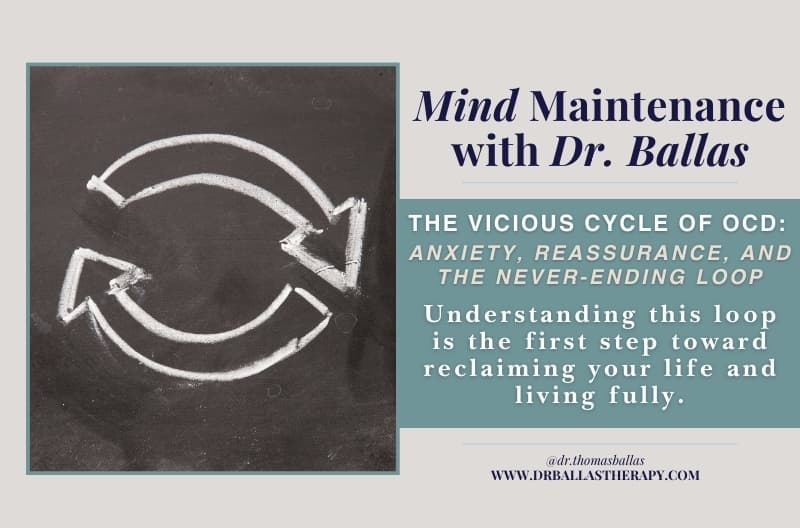
If you’ve ever felt stuck in an exhausting cycle of anxiety and doubt, you’re not alone. At the heart of obsessive-compulsive disorder (OCD) is a self-reinforcing loop that can feel impossible to escape. It all begins with an intrusive thought or obsession—an unwanted idea, image, or doubt that suddenly pops into your mind and immediately sends your anxiety skyrocketing. These thoughts might sound like:
- “What if I didn’t turn off the oven and the house burns down?”
- “What if I accidentally hurt someone and didn’t notice? I must be a terrible person.”
While most people can brush these thoughts aside, OCD latches on and amplifies them, making them feel incredibly urgent and real.
The Trap of Reassurance: A Temporary Fix with a Heavy Cost
When intrusive thoughts take hold, they trigger intense anxiety. To calm that anxiety, people with OCD turn to compulsions—repetitive behaviors or mental actions performed to reduce distress or prevent a feared event from happening. Compulsions can range from physically checking something, like a lock or an appliance, to mentally replaying scenarios or silently reciting phrases.
At its core, reassurance-seeking is an attempt to gain certainty and safety. The first time you engage in a compulsion, you may feel a brief sense of relief—like you’ve solved the problem or confirmed your safety. But that relief is only temporary.
Reassurance is like an addictive drug—the more you rely on it, the more you need it. The momentary calm quickly fades, and the intrusive thought returns, often louder and more persistent than before. This leads to seeking more and more reassurance in increasingly intrusive and time-consuming ways. It might be checking “just one more time,” asking “just one more question,” or engaging in “one last ritual.”
Instead of easing anxiety, reassurance actually strengthens it. It reinforces the idea that the intrusive thought was really dangerous and that the compulsion was necessary to stay safe. It’s a vicious cycle that keeps you trapped.
More Than Just Checking: The Many Faces of OCD Compulsions
Many people assume that OCD is just about checking—such as repeatedly confirming that the stove is off or the door is locked. While checking is one of the most common compulsions, OCD takes many forms:
- Testing: This might involve intentionally putting yourself in a situation to “prove” that something is safe. For example, if you’re afraid of leaving the stove on, you might turn it off and back on again multiple times to convince yourself it’s truly off. If you worry about offending someone, you might reread an email over and over, testing whether you can spot anything that could be misinterpreted.
- Rituals: These can be both mental and physical. Mental rituals include silently repeating a phrase for “protection,” counting to a specific number, or mentally reviewing past events to “ensure” nothing went wrong. Physical rituals could include tapping objects a certain number of times or arranging items in a precise order.
Regardless of the form compulsions take, they only provide a temporary sense of control. In the long run, they reinforce the very fears they are meant to neutralize.
The Never-Ending Loop: How OCD Feeds Itself
Let’s break it down step by step:
- You’re about to leave for work when a thought intrudes: “What if I left the iron on?”
- A wave of anxiety washes over you.
- To calm your anxiety, you go upstairs to check the iron.
- You see it’s off—relief! But as you step out the door, doubt creeps back in: “Are you absolutely sure? What if you misread the switch?”
- You check again. And again. Each time, the relief is fleeting, and the doubt returns even stronger.
- Before you know it, you’re late for work, mentally drained, and frustrated for being stuck in the same loop.
Now, let’s take it a step further. OCD isn’t always about checking physical things like irons, hair curlers, or locks. It can also target intangible fears, such as:
- “What if I’m a bad person?”
- “What if I said something offensive?”
- “What if I made a mistake and hurt someone without realizing it?”
These thoughts are even harder to “prove wrong,” making the reassurance cycle even more relentless. You might replay conversations in your head, analyze every word and gesture, or seek reassurance from a friend:
- “Do you think I was rude?”
- “Was what I said offensive?”
If your friend reassures you that everything was fine, you might feel better—for a moment. But soon enough, doubt creeps back in, and the cycle starts all over again.
The Emotional Toll of OCD’s Cycle
Living in a constant loop of anxiety, reassurance, and doubt is exhausting and takes a toll in every area of life:
- Work & Productivity: Checking, testing, and rituals can eat up hours of your day, making it hard to focus or meet deadlines.
- Relationships: Seeking reassurance from loved ones might provide temporary comfort, but over time, it can strain relationships. Friends and family may feel frustrated, confused, or overwhelmed by your constant need for validation.
- Self-Esteem: OCD’s relentless nature can leave you feeling defeated, ashamed, and out of control, leading to frustration, low self-worth, and even depression.
- Personal Growth: Time spent on compulsions is time taken away from living a fulfilling, values-driven life. OCD can steal your time, enjoyment of hobbies, and progress toward personal goals, leaving you feeling stuck.
Breaking Free: Learning to Resist the Cycle
The good news? OCD is treatable.
One of the most effective therapies is Exposure and Response Prevention (ERP). ERP focuses on breaking the connection between intrusive thoughts and compulsive behaviors. In treatment, you gradually expose yourself to the source of your anxiety—like leaving the house without checking the stove—and resist the urge to perform the compulsion.
Other helpful tools include:
- Mindfulness: Teaches you to observe intrusive thoughts without reacting to them, creating space between you and your anxiety.
- Self-Compassion: Reminds you that OCD is not your fault and that recovery is a process. It’s okay to struggle, and it’s okay to take small steps forward.
Moving Toward Freedom
So, how do you escape the vicious cycle?
The first step is understanding that reassurance and compulsions are traps. They might feel like solutions, but they actually fuel OCD. Instead of providing lasting relief, they keep you stuck in an endless loop.
Each time you resist the urge to seek reassurance or perform a compulsion, you weaken OCD’s grip. Over time, these small victories add up, leading to greater freedom and a more fulfilling, values-driven life. Remember, you are not alone. With the right support and tools, you can break free from OCD and reclaim your life.