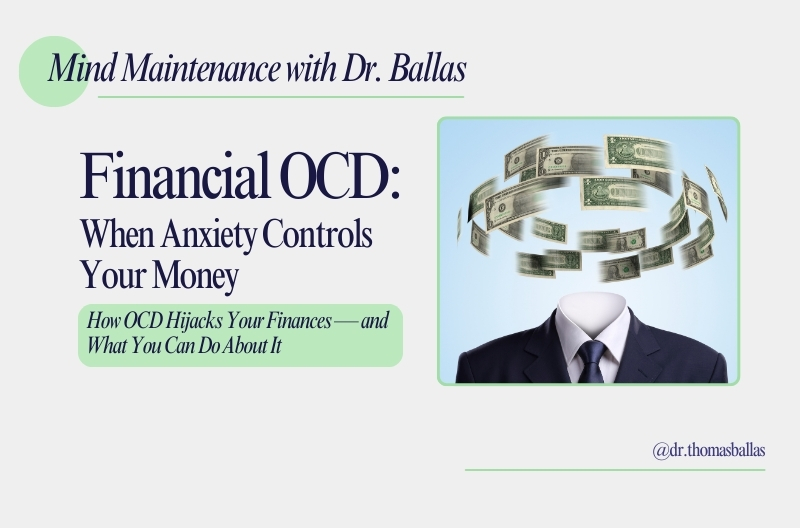
But for people with OCD, these thoughts do not just come and go—they stick, repeat, and start to feel like emergencies.
Financial OCD is not about being “good with money.” It is not just careful budgeting, planning, or saving. It is an obsession with getting it exactly right, avoiding any possible mistake, and feeling completely certain that no financial catastrophe is looming. On the outside, the behaviors can look logical or even responsible. On the inside, they are driven by fear—and they keep the anxiety loop going.
Someone with Financial OCD might:
- Spend a lot of time re‑checking account balances, convinced something is off, even after confirming the numbers multiple times.
- Avoid buying needed items, like groceries or clothing, because of fear of being wasteful or irresponsible.
- Buy the cheapest or least expensive option that they don’t want out of fear; when they really would be able to afford an alternative.
- Keep extensive spreadsheets or tracking systems that go far beyond what is actually useful.
- Ask a partner or loved one for reassurance after almost every purchase, worried they have done something wrong.
Like other OCD themes, this is not really about the content (money) itself. It is about the relationship to uncertainty, the fear of being irresponsible, and the mental rituals used to quiet the noise.
More Than Everyday Money Worries
Feeling stressed about money is extremely common. Big life changes, job transitions, economic instability, or an unexpected expense can make almost anyone worry about debt, savings, or “getting it right.” Financial stress by itself does not mean someone has OCD.
With Financial OCD, the pattern looks different. The anxiety becomes chronic and looping, and it often does not match the actual level of financial risk. The brain starts insisting on 100% certainty about every decision, every dollar, and every possible outcome. Even when the numbers are stable, the worry does not let up.
You may be crossing the line from money stress into Financial OCD when:
- The fear feels out of proportion to reality (for example, intense panic over a very small or routine expense).
- Distress continues despite reassurance, solid budgeting, or an objectively stable financial picture.
- You feel pulled into rituals like checking, researching, avoiding, or seeking reassurance.
- Logic helps for a moment, but anxiety really settles only after a compulsion—and even then, only temporarily.
Financial OCD is not driven by how much money you have or how “smart” your system is. It is driven by the need for certainty, and that is what makes it different.
When Every Dollar Feels Like a Moral Test
At its core, Financial OCD is rarely just about money. It is about fear of failure, fear of being irresponsible, and fear that one mistake could permanently harm you or the people you care about. Money starts to feel like proof of whether you are a “good” person.
The inner story might sound like:
- “If I overspend, I’ve done something bad.”
- “If I miss a charge, it means I’m careless.”
- “If I don’t catch every possible risk, I’m failing my family.”
Each decision starts to feel like a moral test: responsible and careful, or selfish and reckless. That moral weight is part of what makes Financial OCD so sticky. You are not just managing numbers; you are carrying shame, guilt, and dread on top of those numbers. And because no one can guarantee perfect choices or outcomes, OCD’s demand for certainty is never truly satisfied.
This can be especially confusing when people praise your habits. Being told you are “so responsible” or “great with money” can reinforce the idea that being hyper‑vigilant is the “right” thing to do—even when you know it is driven by anxiety, not values. That external praise can unintentionally strengthen internal compulsions.
How OCD Hijacks Money Decisions
Many people with Financial OCD describe feeling stuck or frozen by even small choices. A simple question like “Should I buy this coffee?” can quickly turn into:
- “What if I regret this later?”
- “What if this is part of a bigger pattern of irresponsibility I’m not seeing yet?”
- “What if this one decision is the start of ruining my future?”
Instead of making a choice and moving on, the internal debate keeps expanding. Time and mental energy get pulled into reviewing, rethinking, and replaying decisions. Over time, that can look like:
- Putting off or avoiding financial decisions altogether.
- Spending hours going over the same numbers, transactions, or scenarios.
- Feeling exhausted, resentful, or overwhelmed whenever money comes up.
Ironically, finances may become more disorganized—not because you do not care, but because of compulsive over‑control. Some people swing between strict over‑monitoring and complete avoidance, alternating between burnout and guilt.
It is common to think, “I just want someone else to manage my money.” But the deeper issue usually is not the budget itself—it is the relationship with uncertainty and responsibility.
Financial OCD vs. Perfectionism
Perfectionism and OCD can overlap, but they are not the same thing. Perfectionism might involve:
- High personal standards.
- A strong preference for order, structure, and “doing things right.”
- Feeling disappointed when things fall short of those standards.
OCD, including Financial OCD, involves:
- Intrusive, unwanted thoughts that feel sticky and hard to dismiss.
- Intense anxiety or distress in response to those thoughts.
- Compulsions—behaviors or mental rituals—aimed at reducing that distress or preventing something bad from happening.
A perfectionist might spend extra time fine‑tuning a budget because they like structure or value accuracy. Someone with Financial OCD might spend hours stuck on that same budget because it feels like the only way to prevent catastrophe, even when they are exhausted and want to stop. In OCD, fear—not preference—is driving the behavior.
Seeing this difference more clearly can help explain why reassurance, logic, or “just relax” rarely creates lasting change with Financial OCD. It is not about wanting a high standard; it is about trying to escape the feeling of doubt.
Why Logic and Reassurance Don’t Last
Many people with Financial OCD are very aware that their fear is out of proportion. Part of them might know they are not actually at risk of losing everything over a small purchase or a single missed transaction. Yet the anxiety still feels urgent and convincing.
In the moment, rituals like checking, asking for reassurance, or re‑doing a budget can bring real relief. The challenge is what the brain learns from that relief. Each time a compulsion “works,” even briefly, the brain gets the message:
- Anxiety means something is wrong.
- Compulsions are how you get back to safety.
Over time, this strengthens the OCD cycle. The more you rely on rituals to feel okay, the less practice you get in tolerating uncertainty without them. The bar for feeling “safe enough” keeps rising. What once felt like adequate checking starts to feel inadequate, and rituals can grow more frequent or more elaborate.
ERP: Learning to Spend With Uncertainty
Exposure and Response Prevention (ERP) is the gold‑standard, evidence‑based treatment for OCD, including Financial OCD. The goal of ERP is not to make you reckless with money. It is to help you build a different relationship with uncertainty, guilt, and the urge to neutralize every doubt.
ERP has two main pieces:
- Exposure: Gradually approaching the thoughts, situations, and decisions that trigger your financial anxiety—things like making a purchase, looking at a statement, or leaving a spreadsheet “unfinished.”
- Response Prevention: Choosing not to engage in your usual compulsions—like re‑checking, asking for reassurance, or endlessly re‑calculating—and allowing the discomfort to rise and fall on its own.
Some ERP exercises for Financial OCD might include:
- Making a small, values‑based purchase (for example, coffee with a friend) without checking your account first.
- Reducing how often you review your budget or bank account—moving from many times a day to once daily, then once per week.
- Leaving a low‑stakes transaction unreviewed, even when the urge to double‑check is strong.
- Practicing self‑talk such as, “Maybe this wasn’t the perfect choice, and I’m allowed to live with that uncertainty.”
ERP often works best alongside simple, non‑compulsive financial routines. You might decide to review your accounts only at scheduled times and intentionally avoid opening banking apps outside those windows unless there is a clear, concrete reason. The goal is not to ignore your finances, but to step out of compulsive checking that promises certainty and delivers more anxiety.
ERP is rarely comfortable at first. Anxiety often rises when rituals are reduced. Over time, though, your nervous system learns that anxiety can peak and fall without needing to be “fixed” by compulsions. That is where flexibility and freedom start to grow.
Shame, Secrecy, and the Inner Critic
Shame is one of the most painful parts of Financial OCD. Many people feel embarrassed to talk about what they are going through. They worry they will sound irrational or be judged as ungrateful, careless, or “bad with money.”
That shame often leads to secrecy, and secrecy tends to give OCD more power. When the struggle stays hidden, the internal critic usually gets louder:
- “Why are you like this?”
- “You should have this figured out by now.”
- “You’re a burden.”
That voice is not the truth of who you are. It is the voice of the disorder.
Naming Financial OCD for what it is can create a little bit of space between you and that critic. From there, it becomes easier to see your behaviors as learned patterns rather than personal failures. Working with an OCD‑informed therapist, and when possible sharing your experience with trusted loved ones, can reduce isolation and open the door to a more compassionate perspective.
Letting Go of Perfect Control
Financial OCD can be deeply isolating. It is easy to feel like you are the only one who agonizes over every dollar, every spreadsheet cell, every possible outcome. If that sounds familiar, you are not alone—and you are not broken.
Recovery is not about becoming perfectly rational or finding a flawless financial system that finally makes you feel safe forever. It is about:
- Being willing to not know and still choose what matters.
- Letting go of rituals that promise certainty but keep you stuck.
- Spending, saving, and planning in ways that are grounded in your values rather than your fears.
Money will always involve some uncertainty. No one can predict every curveball or guarantee a smooth path. OCD insists you must eliminate doubt before you can feel okay. Treatment helps you discover something different: you can make room for doubt and still move toward the life you care about.
You can learn to make space for discomfort. You can spend in line with your values. You can stop chasing certainty and start building confidence instead. And in doing so, you begin to reclaim not just your finances, but your peace of mind.