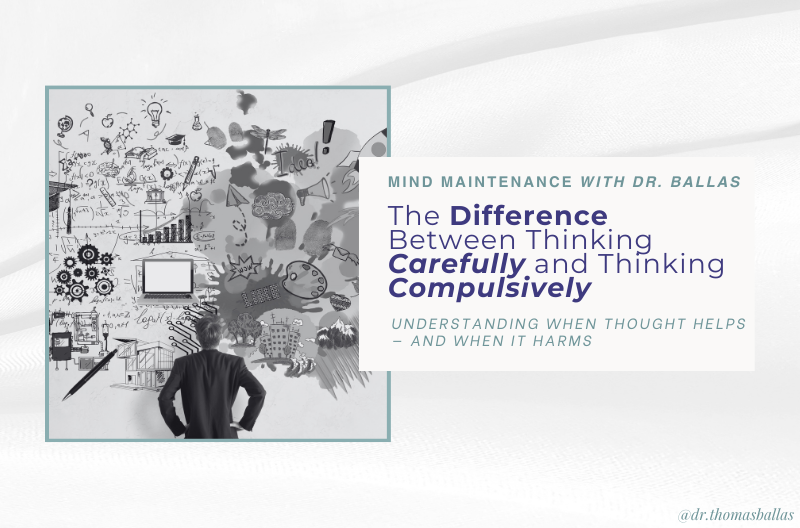
A lot of clients tell me that their OCD does not feel chaotic or irrational. It feels responsible. It feels like they are being thorough, ethical, or self-aware. They are not checking doors or washing their hands. They are reviewing conversations, analyzing motives, replaying memories, or questioning their values. From the outside it looks like reflection or problem solving. From the inside it feels exhausting.
One of the most common things I hear is, “I honestly don’t know where the line is anymore between being thoughtful and being stuck.”
That confusion is part of the disorder.
Why the Content Matters Less Than the Process
People with OCD usually focus on the topic of their thoughts. They want to know whether the concern is legitimate. Is it reasonable to worry about this? Am I missing something important? What if this is the one time I should not let it go?
But OCD is not maintained by just intrusive thoughts. It is maintained by the relationship to uncertainty. Two people can think about the same question about relationships, morality, health, or identity and have completely different experiences. One person reflects, makes a decision, and moves on. The other keeps circling and never feels finished.
The difference is not intelligence or insight. It is function.
Careful thinking moves you toward action or acceptance. Compulsive thinking keeps you trying to feel settled before you live your life.
What Careful Thinking Actually Feels Like
When thinking is working for you, it tends to feel chosen rather than forced. You can engage with a topic, step back, and return later if needed. There is a sense of flexibility. You might not have full certainty, but you can tolerate that and still decide how to move forward.
It also has a natural endpoint. You either make a choice, accept that there is no perfect answer, or consciously set the question aside. You do not need to feel emotionally calm in order to stop. And your self-worth does not feel like it is on the line if you do not get it exactly right.
What Compulsive Thinking Feels Like
Compulsive thinking has a different quality. It is driven by pressure rather than curiosity. The mind keeps returning to the same question with slightly different wording, hoping this time it will finally feel complete.
Clients often describe it as knowing they are not getting anywhere but feeling unable to stop. They say things like, “I’ve already thought about this for hours, but I can’t let it go,” or “I know I’m repeating myself, but stopping feels irresponsible.”
That is not a failure of discipline. It is a learned loop. The brain has been trained to treat thinking as a way to manage distress, even when it no longer works.
Repetition Without Progress
A helpful sign that thinking has become compulsive is whether anything new is actually emerging. Are you gaining information or perspective, or are you mentally retracing the same ground?
Careful thinking allows for “good enough.” Compulsive thinking demands certainty and punishes you when you cannot reach it. That is why it is so draining. It never quite resolves. It just quiets the discomfort temporarily before the next wave of doubt appears.
How OCD Shrinks Your World
Another difference is how much space the thinking takes up. When thinking is healthy, it lives alongside the rest of your life. You can reflect and still go to work, enjoy time with friends, or stay present with what you are doing.
When it becomes compulsive, it takes over. One unresolved question starts to feel like the prerequisite for peace, rest, or enjoyment. The mind treats that doubt as something that must be handled before anything else is allowed.
This often shows up as moral pressure. If you stop thinking, you feel careless. If you move on, you feel dishonest. That pressure feels meaningful, but it is actually coercive.
Why Knowing It Is OCD Does Not Fix It
Most people eventually realize their thinking is not helping. They may even name it as OCD. Yet the urge to keep analyzing remains.
That is because this is not just about beliefs. It is about learning. The brain has learned that intense thinking sometimes brings a brief sense of relief or control, so it keeps reaching for that strategy even when the cost is high.
This is why telling yourself to stop rarely works, and why criticizing yourself only tightens the loop.
Shifting From Thinking to Responding
Recovery is not about eliminating thought. It is about changing how you respond to the urge to think.
When your mind insists that you must analyze in order to feel okay, the problem is no longer informational. It is experiential. The work becomes learning how to let discomfort exist without immediately trying to reason it away.
That feels counterintuitive for people who value responsibility and insight. It can feel like giving up. In reality it is discernment. You are choosing not to engage when thinking has stopped serving you.
What Progress Looks Like
Progress here is subtle. It looks like noticing when your thinking shifts from useful to pressured. It looks like leaving some questions unresolved on purpose. It looks like taking action before certainty shows up.
That is not lowering your standards. It is refusing to let OCD decide when you are allowed to live your life.
You do not need perfect clarity to move forward. You need the willingness to carry uncertainty with you. That is not avoidance. It is a skill, and it can be learned.