These questions can lead to the fear that something is fundamentally wrong with the relationship.
These thoughts can feel especially convincing because attraction and desire are naturally fluid experiences. They can change depending on many factors, like stress, mood, or even how much sleep you’ve gotten. While this variability is normal, ROCD treats it as evidence that something is wrong.
Someone might notice a moment of muted attraction and immediately start scanning for answers. This can involve replaying past experiences, comparing their partner to others, or checking how their body is responding to see if the desire feels “right enough.” When this happens, sex can stop being an experience and become a test. Attraction is no longer something you feel, but something you evaluate.
It’s important to understand that ROCD isn’t revealing a hidden truth about your relationship. It’s exploiting the fact that attraction and desire don’t behave like on-off switches. OCD wants certainty in an area of life that doesn’t offer it.
Instead of allowing attraction to ebb and flow naturally, the mind starts to monitor it. Once you start monitoring an internal experience, it almost always changes. Desire becomes harder to access when it’s under surveillance, and chemistry can feel forced when it’s being checked for authenticity. Then, ROCD steps in with a familiar conclusion: “See? This proves something is wrong.” What’s actually happening is that attention, pressure, and fear are interfering with a normal and variable human experience.
Why These Doubts Feel So Convincing
Doubts about attraction and sex often feel more threatening than other ROCD thoughts because they’re tied to cultural narratives about love. We’re taught that if a relationship is “right,” attraction should be consistent and desire should feel effortless. ROCD latches onto those myths.
It tells you that fluctuating desire means you’re incompatible, or that moments of disinterest mean you’re being deceptive. For someone without OCD, these thoughts might pass. For someone with ROCD, they demand a resolution. The problem isn’t the thought itself, but the urgency that gets attached to it. ROCD doesn’t just suggest an interesting thought; it demands that you figure it out now. That urgency is what turns normal human variability into a crisis.
What Makes This Loop So Hard to Escape
Once attraction becomes something you feel you have to be sure about, the relationship can start to feel fragile. People often respond by trying harder to feel more, check more, or reassure themselves more. They might compare their current relationship to past ones, scroll through social media for confirmation of how love “should” look, or repeatedly ask others if their doubts sound normal. Some even try to manufacture certainty by testing their reactions in real time, constantly asking themselves, “Do I feel turned on right now?”
Unfortunately, all of these strategies keep your attention locked on the very thing that can’t be forced. Attraction and desire don’t respond well to pressure; they tend to retreat under scrutiny. This is one of the cruel ironies of ROCD. The harder you try to be sure, the less sure you feel.
What Recovery Looks Like in This Area
Recovery doesn’t involve proving that you’re attracted “enough” or that your relationship meets some invisible standard. It involves changing how much authority these doubts have over your behavior. Instead of asking, “Am I attracted enough?” the work becomes noticing the urge to answer that question and choosing not to engage with it.
This might mean allowing uncertainty about attraction to exist without trying to resolve it. It could involve staying present during intimacy without checking how you’re responding, or choosing to connect with your partner even when your mind is running commentary in the background. This doesn’t make attraction disappear. For many people, it actually allows attraction to return more naturally, not because it was forced, but because the pressure around it has eased.
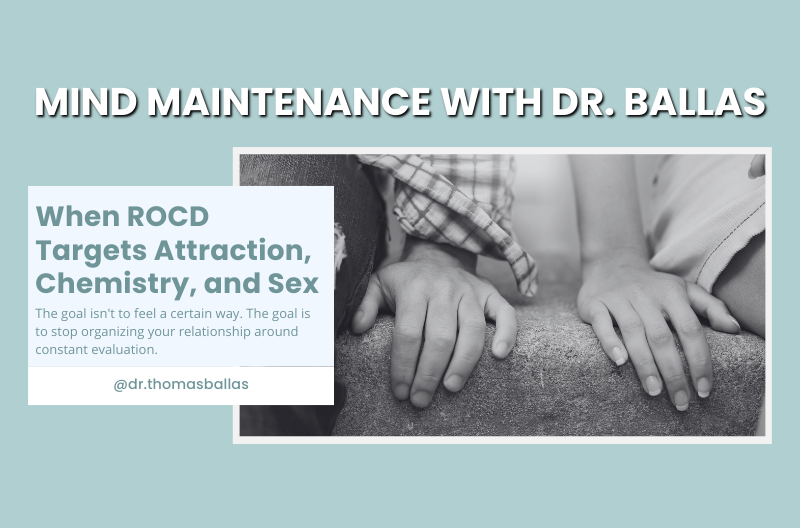
But feeling a certain way isn’t the goal. The goal is to stop organizing your relationship around constant evaluation.
A More Honest Way to Think About Love
ROCD thrives on the idea that love should feel certain and consistent. Real relationships don’t work that way. Attraction shifts, desire fluctuates, and connection deepens and thins and deepens again. None of that means you’re doing something wrong.
Love isn’t proven by a feeling that never wavers. It’s expressed through how you show up, especially when your mind is uncertain. ROCD asks you to decide on your relationship based on how you feel in any given moment. Recovery asks something quieter but harder: to let uncertainty be present without letting it run the show.