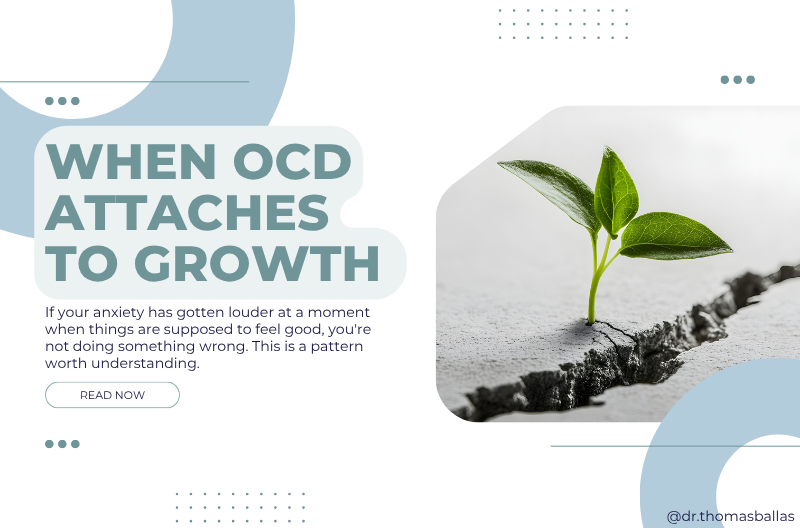
But there’s another pattern that often catches people off guard, especially those who have been doing steady work in therapy. OCD doesn’t always get louder when things are falling apart. Sometimes, it gets louder when things are actually moving forward.
Life might start to open up a little. A relationship could feel more real, or work may begin to feel more aligned. Confidence can grow in ways that once felt out of reach. There’s a sense, maybe subtle at first, that things are changing. Instead of feeling relief, doubt can creep back in. Anxiety may sharpen, and the urge to check, reassess, or slow things down can return.
People often come in confused by this, wondering why symptoms would intensify at a moment that’s supposed to feel positive. It can feel discouraging, even defeating, as if progress somehow triggered the problem rather than resolved it. In most cases, though, this isn’t a sign that something has gone wrong. It’s a sign that something unfamiliar is happening.
What Growth Does to a Nervous System Shaped by OCD
OCD is often framed as a disorder of fear, but that isn’t the whole picture. Predictability matters just as much. Over time, many people with OCD develop ways of living that, while restrictive, feel known. The limits are familiar and the rules are internalized. There’s a sense of how to manage, even if that management comes at a cost.
Growth disrupts that balance. When life expands, predictability decreases. New roles don’t come with clear instructions. New confidence doesn’t come with guarantees about how long it will last or what it might change. For a nervous system that has learned to equate certainty with safety, that kind of openness can feel destabilizing. Even when the change is welcome, it introduces a level of ambiguity that the system hasn’t learned how to tolerate yet.
This is often why OCD symptoms feel more intense during periods of progress. The brain isn’t responding to danger so much as to novelty. It’s trying to regain its footing in a situation that doesn’t yet feel mapped out.
Why Doubt Often Shows Up Just as Things Improve
What surprises many people is that the uncertainty triggered by growth isn’t always about things going badly. Often, it’s about things going well and not knowing what that will mean. Questions can start to surface quietly, like, “What if this version of my life doesn’t stick?” or “What if I change in ways I can’t undo?”
These aren’t catastrophic fears in the usual sense. They’re questions about identity and direction. OCD tends to respond strongly to those kinds of questions because they don’t have clean answers. There’s no way to think your way to certainty about who you’ll become or how growth will unfold.
So, OCD does what it knows how to do. It introduces hesitation and frames slowing down as a form of wisdom. It presents doubt as something that needs to be resolved before you’re allowed to continue. From the inside, this can feel like being careful or thoughtful. But over time, it can quietly pull people back toward familiar ground, even when that ground is limiting.
How People Start to Contain Themselves Again
When growth feels activating, most people don’t make a conscious decision to retreat. It happens more subtly than that. They might temper their excitement, telling themselves not to get ahead of things. They may delay decisions that would move them further into new territory or monitor their reactions closely to see if they feel settled enough to proceed. There’s often a sense that once things feel clearer or calmer, then it will be safer to take the next step.
This approach makes sense in the short term because it reduces internal friction and keeps uncertainty at a manageable level. The problem is that growth rarely feels settled. Waiting for certainty often turns into waiting indefinitely. Without realizing it, people can find themselves recreating the same dynamic OCD has always relied on, where life stays conditional and is postponed until their internal state improves.
Learning to Read Discomfort Differently
One of the more subtle shifts in recovery involves changing how discomfort is interpreted. Not every spike in anxiety or doubt is a signal that something is wrong. Sometimes, it’s simply the nervous system encountering something new.
Growth stretches existing patterns and asks the system to update expectations that have been in place for a long time. That update process isn’t smooth and often comes with noise. OCD tends to interpret that noise as danger. Recovery involves learning to tolerate the noise without immediately reorganizing your life around it. This doesn’t mean ignoring your judgment or pushing recklessly forward. It means not letting discomfort automatically decide whether you stop or continue.
What Moving Forward Actually Looks Like
Recovery in this context doesn’t mean OCD stops reacting to growth. It usually doesn’t. What changes is the relationship to that reaction. People begin to move forward even while doubt is present. They allow uncertainty to accompany progress instead of treating it as something that must be resolved first. Growth starts to feel less like a test that needs to be passed and more like a process that unfolds unevenly.
Over time, the nervous system learns something it couldn’t learn while everything stayed contained: that expansion doesn’t automatically lead to harm, and that uncertainty can be carried rather than eliminated.
Closing Thoughts
If OCD feels louder at moments when your life is getting bigger, it doesn’t necessarily mean you’re doing something wrong. Often, it means you’re stepping into territory that hasn’t yet become familiar.
Growth disrupts certainty, and OCD resists that disruption. Recovery isn’t about restoring certainty before moving forward. It’s about learning that you don’t need certainty in order to keep going.