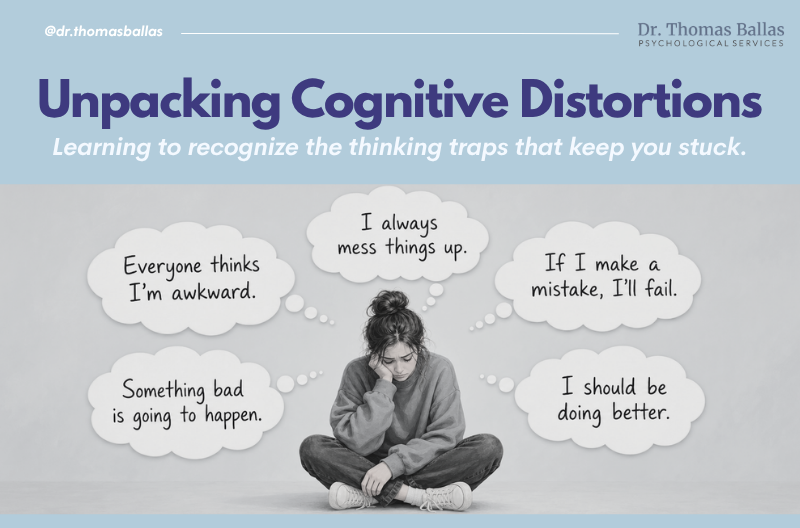
These reactions feel true in the moment. That’s what makes them so easy to miss. They’re not dramatic. They just become the way you interpret things. Over time, they can quietly shape how you feel about yourself, how you make decisions, and how you relate to other people.
This is what cognitive distortions are. Not a personality flaw, and not a sign that something is fundamentally wrong. They’re habitual patterns of thinking that developed over time, often as a way to manage uncertainty or avoid something painful. And they tend to show up most prominently in people dealing with anxiety, depression, and OCD.
What Are Cognitive Distortions?
Cognitive distortions are automatic errors in how we interpret situations. They’re not deliberate. Most of the time people aren’t even aware they’re happening. The thought just arrives and feels accurate.
What makes them problematic isn’t that they’re negative. It’s that they’re consistently skewed in a particular direction, and they’re applied broadly, often to situations where they don’t fit. A single piece of critical feedback becomes evidence of overall incompetence. One canceled plan becomes proof of a character flaw. A friend’s delayed response becomes confirmation that something is wrong in the relationship.
That kind of thinking, repeated often enough, creates a lot of unnecessary distress. It also tends to drive behavior in ways that make the underlying belief harder to update.
How They Show Up in Everyday Life
A few of the more common patterns worth knowing:
All-or-nothing thinking is when outcomes get sorted into two categories with nothing in between. Either the presentation went well or it was a failure. Either you handled it perfectly or you didn’t handle it at all. This kind of thinking tends to set a standard that’s almost impossible to meet and then treats anything short of that standard as a complete loss.
Catastrophizing is jumping to the worst-case interpretation of a situation. A physical symptom becomes a serious illness. A tense conversation becomes the end of a relationship. The actual probability of the feared outcome doesn’t factor in much. The mind goes straight to the worst version.
Mind reading is assuming you know what someone else is thinking without any real evidence. Usually the assumed thought is negative. “She seemed distracted during our conversation, so she’s probably annoyed with me.” The assumption then gets treated as fact.
Emotional reasoning is using how you feel as evidence for what’s true. “I feel like I said something wrong, so I must have.” “I feel guilty, so I must have done something bad.” The emotion becomes the proof.
Should statements are rigid internal rules about how you or others are supposed to behave. “I should be able to handle this without feeling anxious.” “I shouldn’t need help with this.” When reality doesn’t match the rule, the result is usually shame or frustration rather than any useful adjustment.
Labeling takes a specific behavior and turns it into a fixed identity. Instead of “I made a mistake,” it becomes “I’m a failure.” Instead of “I didn’t follow through on that,” it becomes “I’m unreliable.” Labels are hard to update because they feel like descriptions of who you are rather than observations about what happened.
Why They Stick Around
Cognitive distortions tend to persist because they feel functional. Catastrophizing can feel like preparation. Mind reading can feel like a way to stay ahead of rejection. Should statements can feel like motivation. On some level, the brain is trying to protect against something.
The problem is that the protection doesn’t really work. Catastrophizing doesn’t reduce the likelihood of bad outcomes. It just keeps the nervous system in a state of anticipation. Mind reading doesn’t prevent rejection. It just adds anxiety to interactions that might have gone fine. Should statements don’t motivate effectively. They mostly generate shame.
Over time these patterns tend to create the very experiences they’re trying to prevent: more anxiety, more avoidance, more distance in relationships, more self-criticism.
How Intrusive Thoughts Are Different
This is an important distinction, especially for people who have OCD or are in treatment for it.
Cognitive distortions and intrusive thoughts are not the same thing, and they’re not handled the same way.
Cognitive distortions are about how you interpret real-life situations. The thought has a connection to something that actually happened. The problem is that the interpretation is skewed. In that case, it makes sense to slow down and examine the thought. What’s the actual evidence? Is there another way to read this situation? Am I applying a label where a more specific observation would be more accurate?
Intrusive thoughts, particularly in OCD, work differently. They tend to be ego-dystonic, meaning they feel out of alignment with your values and your sense of who you are. They’re not about misreading a real situation. They’re sudden, unwanted thoughts or images that create distress precisely because they don’t feel like you.
The approach to intrusive thoughts is not to examine and challenge them. It’s to notice them, recognize them for what they are, and not engage. Trying to analyze an intrusive thought, argue with it, or figure out what it means is what keeps it going. That analysis becomes a compulsion, a way of trying to get certainty or relief, and it strengthens the cycle rather than interrupting it.
The way to think about it: distorted thinking gets examined and reframed. Intrusive thoughts get noticed and left alone.
This distinction matters a lot in treatment. Applying cognitive restructuring to OCD intrusive thoughts can actually make things worse, because it reinforces the idea that the thoughts need to be resolved. Working with a clinician who understands the difference is important.
What You Can Do About Cognitive Distortions
The first step is just noticing. Most of these patterns operate automatically and below awareness. Starting to catch them in the moment, even after the fact at first, is genuinely useful.
When you do notice one, the goal isn’t to argue it into submission or immediately replace it with something positive. The goal is to create a little distance between the thought and the reaction. To ask whether the interpretation you landed on is the only one available, or just the most automatic one.
Some useful questions: What’s the actual evidence here? Is there another way to read this situation that’s also consistent with the facts? Would I apply this same standard or interpretation to someone I care about?
This isn’t about talking yourself into feeling better. It’s about building more flexibility in how you evaluate things, so that your responses are based on what’s actually happening rather than on a well-worn pattern that may not fit the situation.
CBT and ACT are both well-suited to this kind of work. A therapist can help you identify which patterns tend to show up most for you and build more personalized strategies for responding differently over time.
A Note on Expectations
Changing habitual thought patterns takes time. The point isn’t to think perfectly or to never land on a distorted interpretation again. It’s to get better at noticing when it’s happening, and to have more options available for how to respond when it does.
The goal is more flexibility. Not a different set of rigid rules, but a more honest and workable relationship with your own thinking.
Cognitive distortions aren’t evidence of a broken mind. They’re patterns the brain learned, often for good reasons. And patterns that were learned can, with enough practice and support, be updated.