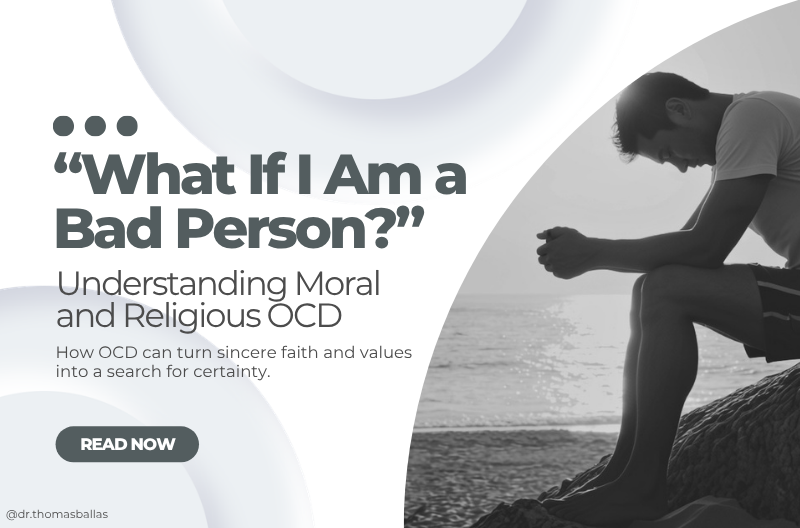
Most people want to be good. They want to be honest, kind, fair, and faithful to whatever they believe in. That desire is what makes someone conscientious.
For a person with scrupulosity, that ordinary desire becomes a source of constant fear. The question stops being how do I live well and becomes what if I’ve already failed. A single stray thought during prayer feels like evidence of blasphemy. A small lie from years ago feels like proof of a corrupt character. The effort to be good stops being a value and turns into a job with no day off and no way to confirm you’ve done it right.
Scrupulosity is a form of OCD centered on moral or religious themes. It is common, frequently misunderstood, and one of the more difficult subtypes to treat without a clinician who recognizes the mechanism underneath it.
Two Overlapping Forms
Scrupulosity tends to show up in one of two related forms.
Religious scrupulosity attaches to faith. A person might fear they have sinned without realizing it, offended a higher power, prayed insincerely, or broken a religious rule. They may restart a prayer many times because it did not feel pure enough, confess the same thing repeatedly because the last confession did not hold, or avoid a place of worship because of an intrusive thought that surfaced there.
Moral scrupulosity does not require religious belief. It is an oversized, intrusive concern with being an ethical person: Did I mislead someone in that conversation? Am I secretly selfish? Did I cause harm without noticing? The person replays interactions searching for wrongdoing, apologizes for things no one else registered, and carries a low, constant hum of guilt that never fully resolves.
In both forms, the underlying value is usually sincere. The person’s faith or ethics genuinely matter to them. OCD takes that real value and turns it into a weapon against them.
Why the Compulsions Are Hard to Spot
What makes scrupulosity especially difficult is that the compulsions look virtuous.
Praying more. Confessing more. Seeking guidance from a religious leader. Reviewing one’s conduct to be sure it was right. In most contexts, these are reasonable and even admirable actions. So when a person with scrupulosity turns to their community for help, the advice they usually receive is to try harder: pray more sincerely, examine your conscience more closely, stay more vigilant.
For someone with scrupulosity, that advice functions as fuel. Each extra prayer, each additional confession, each round of self-examination operates as a compulsion, and it works the way all compulsions work. It relieves the anxiety briefly, then strengthens the underlying cycle. The relief fades, the doubt returns sharper than before, and another round of the same behavior feels necessary.
The obsession-compulsion cycle typically looks like this:
An intrusive doubt appears. Did I do something wrong? Was that thought a sin?
The doubt feels urgent and morally significant.
A compulsion follows: praying again, confessing again, mentally reviewing the moment, seeking reassurance from a religious authority or loved one.
Relief arrives, briefly.
The relief fades, and the next doubt lands with more force, because the brain has learned the doubt required a response.
Because these compulsions are wrapped in something meaningful, scrupulosity often goes unrecognized for years, both by the person experiencing it and by the people they turn to for guidance.
The Certainty That Never Comes
Underneath scrupulosity is the same engine that drives every form of OCD: an intolerance of uncertainty paired with a demand for a guarantee. Here, the guarantee being sought is moral or spiritual. Am I truly good? Am I truly forgiven? Am I certain I didn’t cross a line?
These questions cannot be answered with the kind of certainty OCD demands. No amount of prayer produces confirmation of sincerity. No amount of mental review proves character beyond doubt. The search itself is the problem, because it treats a question meant to be lived with as a problem to be solved once and for all.
Every compulsion is an attempt to reach solid ground, and every attempt teaches the brain that the ground was never solid to begin with, which is why the searching continues.
What Actually Helps
The treatment for scrupulosity is the same evidence-based approach used across OCD: Exposure and Response Prevention (ERP), often alongside Acceptance and Commitment Therapy (ACT). What changes is the sensitivity required to apply it, since the exposures touch on what a person holds sacred.
Good treatment does not ask anyone to abandon their faith or their values. A skilled clinician works to separate the value from the compulsion. Genuine faith can involve trust, surrender, and living with mystery. Scrupulosity involves the opposite: a demand for certainty and control dressed in religious or moral language. Treatment helps a person move toward the former and out of the latter.
In practice, this might mean allowing a doubt to be present without praying it away, ending a prayer once even when it did not feel perfect, making an ordinary decision without seeking reassurance that it was morally spotless, or sitting with the discomfort of not knowing for certain and noticing that the discomfort fades once it stops being fed.
Many people benefit from working with a therapist who can respectfully collaborate with their religious framework, or who can coordinate with a supportive faith leader who understands the difference between a spiritual practice and a compulsion.
If This Sounds Familiar
If you have spent years trying to be good enough and never quite arriving, it is worth considering that the problem may not be your character or your faith. Scrupulosity convinces sincere, thoughtful people that they are always one thought away from moral failure. That relentless doubt is not evidence that you are bad. It is a recognizable pattern, and it responds to the right kind of help.
Trying harder has likely already failed, over and over, because trying harder is the trap itself. The way out runs in a different direction: toward tolerating uncertainty rather than trying to eliminate it.
Important: This article is for education and is not a diagnosis or a substitute for professional care. A clinician trained in OCD can help distinguish scrupulosity from other clinical or spiritual concerns. If you are experiencing distress that feels unmanageable, please reach out to a licensed mental health professional.